


AcademicDec 22, 2020 - On-going
Assistant Professor (Stage-II)
Banaras Hindu University, U.P, India
Teaching & Research
Assistant Professor (Stage-I)
Department of Chemistry
Publications
Research Projects
Ph.D. Scholars
Honours & Awards
A concise academic overview, expertise and current areas of scholarly interest.
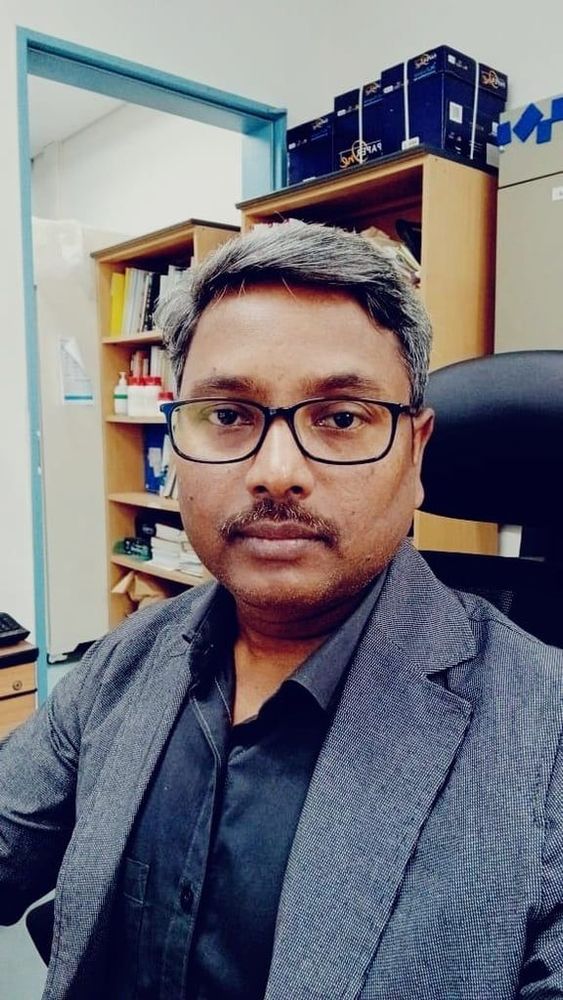
Manivannan S serves as Assistant Professor (Stage-I) in the Department of Chemistry, contributing to teaching, research, student mentorship and academic initiatives.
Academic appointments, research roles, and administrative responsibilities.
Banaras Hindu University, U.P, India
Teaching & Research
Incheon National University, South Korea
Teaching & Research
Incheon National University, South Korea
Research
Incheon National University, South Korea
Research
Madurai Kamaraj Univerisity, T.N, India
Research
Research projects, funding agencies, roles and project timelines.
ANRF-IRG
Hydrogen production technologies are rapidly evolving, but conventional methods like alkaline and PEM electrolysis are energy-intensive and limited by slow oxygen evolution reaction (OER) kinetics, high overpotential, and safety risks. The methanol oxidation reaction (MOR) offers a promising alternative, requiring significantly lower energy (0.016 V vs. 1.23 V) and enabling up to 70% energy savings while producing value-added chemicals such as formic acid. However, the lack of efficient, stable, and scalable bifunctional catalysts remains a key challenge. Current systems rely on costly precious metals, while earth-abundant alternatives face performance limitations. This work focuses on redox-state engineering and scalable synthesis methods to develop cost-effective catalysts. The approach aims to enable low-voltage, stable hydrogen production with chemical co-generation, offering a practical pathway toward decentralized and sustainable hydrogen energy systems.
Rs. 66 Laks
2026-03-01 — 2029-03-01
IoE_Banaras Hindu University
Instrument Grant for establishing the “High-End Electrochemical Workstation" at the Department of Chemistry, Institute of Science, BHU.
Rs. 70 Lakhs
2026-01-01 — 2026-03-01
SERB-SRG/2022/000138
Research Aim: Synthesis of hollow carbon (HC) network by interconnecting HC spheres and its electrochemical applications such as Li-S battery, fuel cell, supercapacitors, and electrochemical sensors. The HC network synthesis is proposed to obtain through solution synthesis of SiO2 spheres and carbon layer coating followed by an optimized two-step calcination process. From the preliminary studies, it was learned that during the optimized calcination process, the SiO2/Carbon spheres were transformed into the SiO2/Carbon network. Careful etching of templated SiO2 spheres would result in an HC network. Such HC network structures are yet unexplored, and we are curious to apply this unique nanostructure for various electrochemical applications.
Rs. 32.5 Lakhs
2022-09-26 — 2024-09-25
IoE Scheme No. 6031 (B), Banaras Hindu University
Two-dimensional (2D) materials have attracted intense interest due to their promising properties, including the direct bandgap, 2D superconductivity, and the quantum spin Hall effect, especially since the single-layer graphene, metal-organic-framework (MOF), and hexagonal boron nitride have come into the picture. Compared with the three-dimensional (3D) bulk materials, the 2D nanosheets (NSs) are more applicable due to the advantages in the uniform dispersion, ultra-smooth surface, large specific area, and massive lateral surface area. However, the partial ionic bonding between the layers and shorter interlayer distance of the 3D bulk materials makes them much more difficult to exfoliate. Solution-based exfoliation of the bulk materials such as chemical, mechanical, and hydrothermal approaches often suffer from the low-yield and aggregation. As a facile approach, it is proposed that galvanic displacement reaction (GDR)-based exfoliation of the pre-deposited transition hexacyanometalate (HCM) 2D flakes into the metal 2D NSs in the presence of chiral ligand onto the electrode surface, which could facilitate the fabrication of free-standing crystalline metal NSs at a low temperature. Most importantly, this GDR-based exfoliation method could be a universal approach for the exfoliation of 2D HCMs. Moreover, the present approach of harvesting the exfoliated, chiral ligand functionalized, and free-standing metal NSs onto the electrode surface can greatly simplify the fabrication procedure for device applications and should be of both fundamental and technological impact in emerging exfoliated metal NSs-based devices.
Rs. 15 Lakhs
2022-01-01 — 2025-01-01
IoE_Trans-Diciplinary Project, Banaras Hindu University
Soil takes hundreds or thousands of years to form, it can be destroyed in a matter of years if not managed correctly. The management and conservation of the soil environment is arguably the biggest challenge we face as we move into the future. We need new ideas to solve the world's problems. The effect of nanomaterials on the plant system depends on the physicochemical characteristics of the nanomaterials like size, shape, surface properties, aqueous solubility, dispersibility, etc. Moreover, many Agri-nanotechnology researchers are exploring the potential of nanomaterials for protecting crops from insect pests and phytopathogenic microbes, imparting stress tolerance in plants, soil enrichment, and precision farming. Nanomaterials have high application potential in all these areas because of their unique size-dependent properties like the high surface area to volume ratio, enhanced reactivity, etc. It was observed that due to their ultrasmall size, these nanomaterials get impregnated within the cuticular layer of the insects and cause damage to this protective layer by abrasion. Some porous nanomaterials were also found to suck up lipid from the insect cuticle by capillary action. All these led to water loss from the insect body through a damaged cuticle and caused mortality because of desiccation. Similarly, a nano carrier-based delivery system ensured the slow and controlled release of agrochemicals in the field. Here, we propose to elaborate on the applications of Metal-, Metal Oxide- and Carbon nanomaterials as smart agrochemicals in sustainable agriculture.
Rs. 10 Lakhs
2023-05-01 — 2025-04-01
Journal articles, conference papers, book chapters and other scholarly work.
S* Manivannan, R Kumar, P Viswanathan, K* Kim
Kumar, S, Kim, K, Manivannan, S*
Manivannan, S* and Kyuwon Kim*
Manivannan, S*, Lee, J-M, Ji, S-Y, Viswanathan, P, Kumari, R, Kyuwon Kim*
Manivannan, S*, Ji, S-Y, Kumar, S, Kumari, R, Kyuwon Kim*
Jinachandran, A, Kokulnathan, T, Manivannan, S, Wang, T-J*, Abburi, J, Shaik, S, Rajapandiyan, P*
Tolani, R and Manivannan, S*
Kumar, R, Viswanathan, P, Kim, K and Manivannan, S*
Kumar, S, Viswanathan, P, Viji, M, Kim, K and Manivannan, S*
Viswanathan, P , Kim, J-W, Manivannan, S and Kim, K
Viswanathan, P, Sivakumar, G, Gowrisankar, A, Tolani, R, Manivannan, S, Kim, K and Ramaraj, R
Viswanathan, P., Lee, D., Manivannan, S., Yim, T. and Kim, K*
Seong, M-J., Manivannan, S., Kim, K., Yim, T*
Seong, M-J. Park, S-G. Kim, H. Manivannan, S. Kim, K. Oh, S-H and Yim, T
Lee, G., Oh, S-H., Park, B-K., Kim, Y., Kim, K-J., Manivannan, S., Kim, K., Yim, T*
Ahn, S., Manivannan, S.*, Viji, M., Shim, M-S., Hwang, B-H. and Kim, K*
Manivannan, S. Lee, D. Kang, D.-K. and Kim, K
Manivannan, S. Kim, H. Viswanathan, P. Yim, T and Kim, K
Manivannan, S. An, S. Jeong, J. Viji, M and Kim, K
Manivannan, S. Park, S. Jeong, J and Kim, K
Manivannan, S. Seo, Y. Kang, D.-K. and Kim, K
Manivannan, S. Kang, I. Seo, Y. Jin, H-E. Lee, S-W and Kim, K
Seo, Y†. Manivannan, S†. Kang, I. S-w, Lee and Kim, K. (†Both authors contributed equally)
Manivannan, S. Kang, I and Kim, K
Viswanathan, P. Manivannan, S and Ramaraj, R
Manivannan, S and Ramaraj, R
Manivannan, S and Ramaraj, R
Manivannan, S. Krishnakumari, B and Ramaraj, R
Manivannan, S and Ramaraj, R
Scholars and research students guided by the faculty member.
Scholar: Ritesh Tolani · Department of Chemistry, Institute of Science, Banaras Hindu University, Varanasi, U.P.
Scholar: Sachin Kumar · Department of Chemistry, Institute of Science, Banaras Hindu University, Varanasi, U.P.
Scholar: Raman Kumar · Department of Chemistry, Institute of Science, Banaras Hindu University, Varanasi, U.P.
Scholar: Reena Kumari · Department of Chemistry, Institute of Science, Banaras Hindu University, Varanasi, U.P.
Courses and academic offerings associated with this faculty profile.
Academic honours, distinctions, prizes and recognitions received by the faculty member.
No honours or awards are currently listed.
Notable academic, professional, research and institutional achievements.
No achievements are currently listed.
Banaras Hindu University
For academic collaboration, teaching enquiries, research discussions or professional communication.